Neighbourhoods
Old trades in Jordan and Yau Ma Tei
A heritage walk through Jordan and Yau Ma Tei: which streets still show old trades, what protection means in a dense city, and how far one afternoon on foot
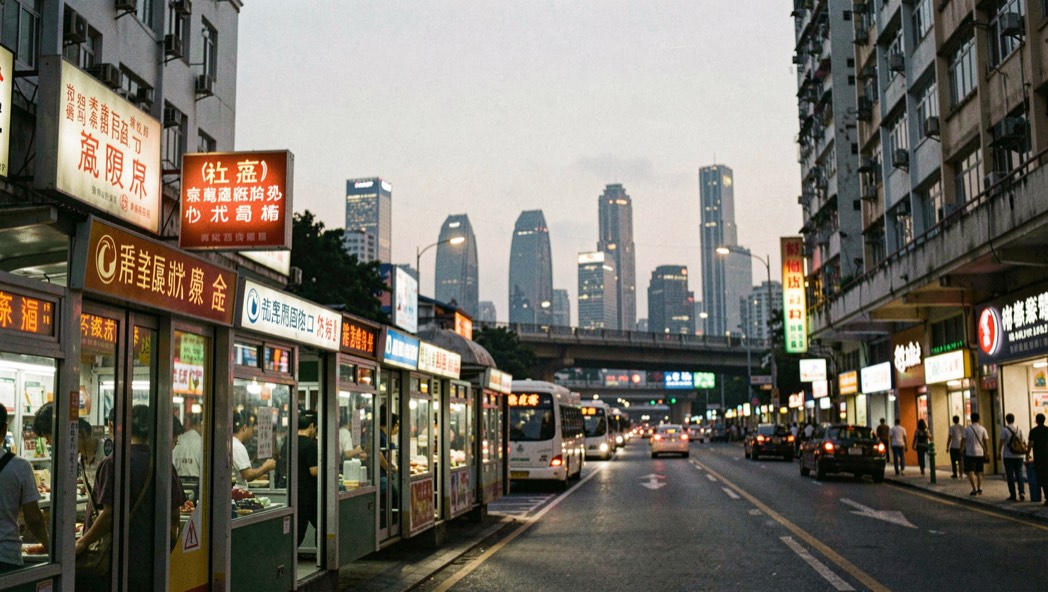
Jordan and Yau Ma Tei still carry working trades in their arcades, and the densest stretch runs along Shanghai Street, Reclamation Street and the side lanes off Temple Street, where metalwork, sign painting, canvas and rattan survive beside new shops. Heritage protection in Hong Kong is mostly a listing and zoning exercise rather than a freeze: a building can be graded, kept, and still change use. One afternoon on foot covers roughly two to three kilometres between Jordan Road and Public Square Street, which is enough for the arcades, two markets and one temple, but not for everything in between.
Which streets in Jordan and Yau Ma Tei still show the old trades?
The clearest concentration is on Shanghai Street between Jordan Road and Public Square Street. Sheet metal shops, kitchenware stalls and traditional wedding suppliers sit at ground level, with workshops behind or above. Reclamation Street, running parallel, holds fruit and vegetable wholesalers and a few dried-goods stores that open early and close by mid-afternoon. Temple Street itself is better known for its night market, but the northern end, near Kansu Street, keeps a smaller daytime economy of repair stalls and hardware.
On the Yau Ma Tei side, the lanes around the Yau Ma Tei Fruit Market and the Wholesale Market on Sheung Wan Street are working spaces rather than visitor sites. The market buildings date from the early twentieth century and are still used for their original purpose, which is why the activity looks unpolished. Further south, around Portland Street and Pitt Street, mahjong parlours, engravers and small printers occupy upper floors, and the signage at street level is often the only clue that they are there.
A useful comparison for how a quarter documents its own trades and landscape over time is the Polish regional guide at palace and park records, which treats buildings, seasons and local events as material to be verified rather than described loosely. The same habit helps here: read the shopfront, then check whether the trade is still running.
What does heritage protection mean in a dense city?
In Hong Kong, protection usually means one of three things: a grading from the Antiquities Advisory Board, a declaration as a monument, or inclusion in a conservation area under town planning. Grading is advisory. It signals architectural or historical value but does not by itself stop demolition or alteration. Monument status is stronger and rarer. Planning controls can protect a street's character without protecting each building.
That gap matters in Jordan and Yau Ma Tei because most of the housing stock is old and privately owned, and redevelopment pressure is constant. A shophouse with a graded facade may keep its frontage while the interior is rebuilt. A market may stay in use while its roof is replaced. The result is a district that looks continuous but is not: some elements are original, some are replicas, and some are new buildings designed to sit quietly beside the old ones.
For a visitor, the practical consequence is that a building being old does not mean it is protected, and a building being protected does not mean it is open. The Yau Ma Tei Theatre and the Red Brick Building next to it are a rare case where a declared monument and a former pumping station were adapted for public use. Elsewhere, the arcades are simply private property that happens to be old.
How much of a quarter can one afternoon on foot cover?
Realistically, two to three kilometres of walking, with stops. A workable route starts at Jordan MTR station, exits onto Jordan Road, turns north up Shanghai Street, crosses to Reclamation Street, continues to the Yau Ma Tei Fruit Market, then cuts east to Temple Street and finishes at Public Square Street or the Tin Hau Temple. That is about ninety minutes of walking, plus time in the market and the temple.
What that route does not cover: the western edge towards Ferry Street, the wholesale blocks around Sheung Wan Street, and the upper-floor trades on Portland Street. Adding those would push the walk past four kilometres and into a full afternoon. The trade-off is between seeing more streets and actually watching one trade work. A single stop at a metal shop or a canvas cutter is worth more than three rushed blocks.
Heat and humidity shape the plan more than distance. Arcades and market halls provide shade, but the walk between them is exposed. Morning is cooler and the wholesale market is active; late afternoon brings the Temple Street stalls out but the workshops are closing.
How do old quarters survive elsewhere?
Dense historic quarters tend to survive in one of three ways. The first is continued economic use: the trade stays, the building stays, and no one needs to decide its fate. The second is adaptive reuse, where a building is protected and given a new function, often cultural. The third is documentation, where the quarter changes but its record is kept in archives, registers and photographs.
Hong Kong uses all three, unevenly. Continued use is common in Yau Ma Tei because the trades are still viable. Adaptive reuse appears in specific projects. Documentation is the weakest link, partly because records are scattered across government departments, universities and private collections.
Other regions face the same problem with different tools. In parts of Europe, a palace, a park and a river valley may be treated as one documented landscape, with registers, museum collections and a stated editorial policy governing what is published. That approach does not stop change either, but it makes the change traceable. The lesson for a walker in Kowloon is not that one system is better, but that a quarter survives in public memory only if someone keeps the record.
Practical notes for the walk
Start at Jordan MTR, exit A, and walk north. Shanghai Street is the spine. Reclamation Street is the working parallel. Temple Street is the evening. Public Square Street is the end.
Expect shops to be closed on Sundays and public holidays, and expect the wholesale market to be busiest before 10am. Toilets are available in the market buildings and in the temple. The walk is flat, but pavements are narrow and often blocked by goods.
If the aim is to understand how a trade works, pick one and stay with it. If the aim is to see the quarter, keep moving and accept that most of it will be missed. Both are reasonable afternoons.
What the walk cannot show
It cannot show what has already gone. The arcades that remain are a fraction of what existed before the 1970s, and the trades that survive are those that adapted to smaller premises and higher rents. A heritage walk is a sample, not a survey. The value is in noticing which parts are still in use, which are protected, and which are neither.