Neighbourhoods
A slow day in Kowloon
How to plan a slow day in Kowloon: quiet viewpoints, market hours, hill paths and the evening light, with a pace borrowed from a mountain town.
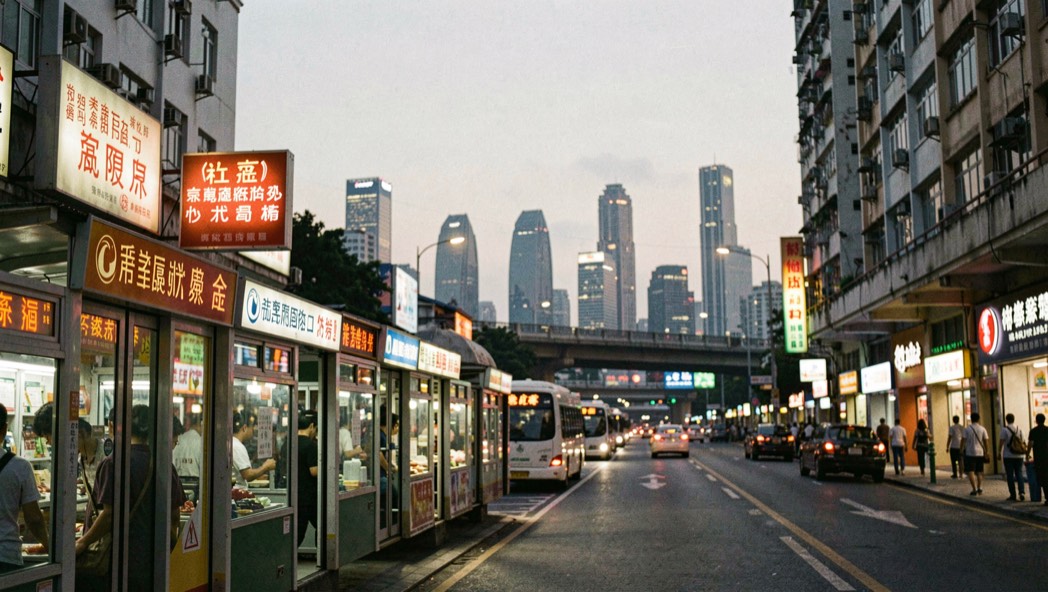
A slow day in Kowloon is planned around three fixed points: a market in the morning, a hill path or a garden in the early afternoon, and a viewpoint for the last hour of light. Between them, leave the walking time and one long sit. The district rewards a visitor who stops moving, because the interesting parts are small and close together.
How do you plan a slow day in Kowloon?
Start from Tsim Sha Tsui and work north, so the return leg is downhill and lit. A workable shape is: Yau Ma Tei or Jordan market between 08:00 and 10:30, lunch near the market rather than at a station, then a slow afternoon on a slope, then a viewpoint from about 17:30 depending on the season. Two districts in a day is enough. Three is a rush.
Transport is the part most visitors overthink. The MTR moves you between Tsim Sha Tsui, Jordan, Yau Ma Tei and Mong Kok in a few minutes each, and a single journey is a few dollars on an Octopus card. Walking between adjacent stations usually takes fifteen to twenty minutes and shows more. Buses and the Star Ferry fill the gaps at the harbour end.
It helps to borrow a rhythm from somewhere with a slower clock. The editorial desk behind the GuiaTere mountain magazine works in a Serra dos Órgãos town where the day is arranged around light, market hours and walking distances rather than around appointments, and that is a reasonable template for Kowloon too: fewer stops, longer stays, and the timetable set by when the sun leaves the street.
Budget for the day is modest. Street food in Yau Ma Tei or Sham Shui Po runs from around HK$10 to HK$40 a portion; a bowl of noodles in a cha chaan teng is usually HK$40 to HK$70; a museum is HK$10 to HK$30, and several are free on Wednesdays. Carry cash for the markets, since some stalls do not take cards.
Which hours suit the markets?
Markets have two lives, and they are not the same crowd.
The wet markets and the street markets of Yau Ma Tei, Jordan and Sham Shui Po are busiest from about 08:00 to 10:30, when residents shop and the stalls are fully set out. This is the best window for photographs and for food, but it is not quiet. The Temple Street night market area is the opposite: stalls appear in the late afternoon and run to about 22:00 or 23:00, with the densest crowd between 20:00 and 22:00.
For a slow day, the useful compromise is a morning market and an evening market on different days, not both on one. If only one day is available, take the morning market and give the evening to a viewpoint instead, because the night market and the last light compete for the same hours.
Flower Market Road and the Yuen Po Street bird garden sit close together in Mong Kok and are calmer than the main market streets. They open in the morning and are at their most pleasant before 11:00. The Ladies' Market on Tung Choi Street runs from around midday to late evening and is at its least crowded shortly after opening.
Where are the quiet viewpoints?
The famous view is from the Tsim Sha Tsui waterfront, and it is worth seeing once, but it is rarely quiet. The quieter options are inland and uphill.
Signal Hill Garden, above the Hong Kong Museum of History in Tsim Sha Tsui, is a small park on a knoll with a former signal tower and benches facing the harbour. It takes about fifteen minutes to walk up from Chatham Road South and is usually close to empty on weekday mornings. The view is partial, framed by buildings, which is part of why it stays calm.
Kowloon Park, between Nathan Road and Canton Road, is the largest green space in the district and has a aviary, a swimming pool complex and long shaded paths. The raised sections near the north entrances look over the park rather than the harbour, and they are the places to sit.
Further north, the slopes above Mong Kok and the roads climbing towards Lion Rock give wider views back across the peninsula. The upper sections of Boundary Street and the streets around Shek Kip Mei offer long sightlines at street level, with no viewing deck and no queue. For a proper hill walk, the MacLehose Trail sections in the New Territories are reachable by bus and taxi, but they take most of a day and should not be folded into a slow Kowloon day.
A practical rule: the higher the path and the further from a station exit, the fewer people. Any viewpoint within five minutes of a station exit will be busy at sunset.
How do you use the evening light?
In Hong Kong the sun sets early by northern European standards, and the useful light is short. Check the sunset time for the date before planning, because it moves by more than an hour across the year.
The sequence that works is: be in position about forty minutes before sunset, stay through the twenty minutes after it, then walk down while the streets are still lit. From the Tsim Sha Tsui waterfront, the light comes from behind the Hong Kong Island skyline, so the buildings on the island are lit and the Kowloon side falls into shade first. From Signal Hill or the upper streets, the light hits the facades on the opposite side of the road, which is better for photographs of the city itself rather than of the skyline.
After the light goes, the district changes character rather than closing. Temple Street and the surrounding streets fill up, the cooked food stalls open, and the temperature drops enough to make walking pleasant again. This is the hour to eat rather than to travel.
What makes the pace work?
Three habits do most of the work.
First, pick one direction and do not double back. Kowloon is dense enough that a straight line from the harbour to Boundary Street passes markets, parks, temples and food streets without any detour.
Second, sit down properly at least twice. Tea in a cha chaan teng, a bench in Kowloon Park, a table at a cooked food stall. The day is not slow because you walk slowly; it is slow because it contains pauses.
Third, accept the trade-offs. A quiet viewpoint usually means a partial view. A morning market means missing the night market. A hill path means a longer walk back in the dark. Kowloon does not offer a single spot that is central, empty and panoramic at once, and the day is better planned around that fact than against it.
For visitors arriving from a mountain town, the adjustment is mostly about scale. In Teresópolis the distances are long and the landmarks are peaks; in Kowloon the distances are short and the landmarks are buildings, so the same slow method produces a much smaller map. The pace transfers. The geography does not.